
In order to understand the coloniality of modern scholarship on India, you have to start with the mythology of the West.
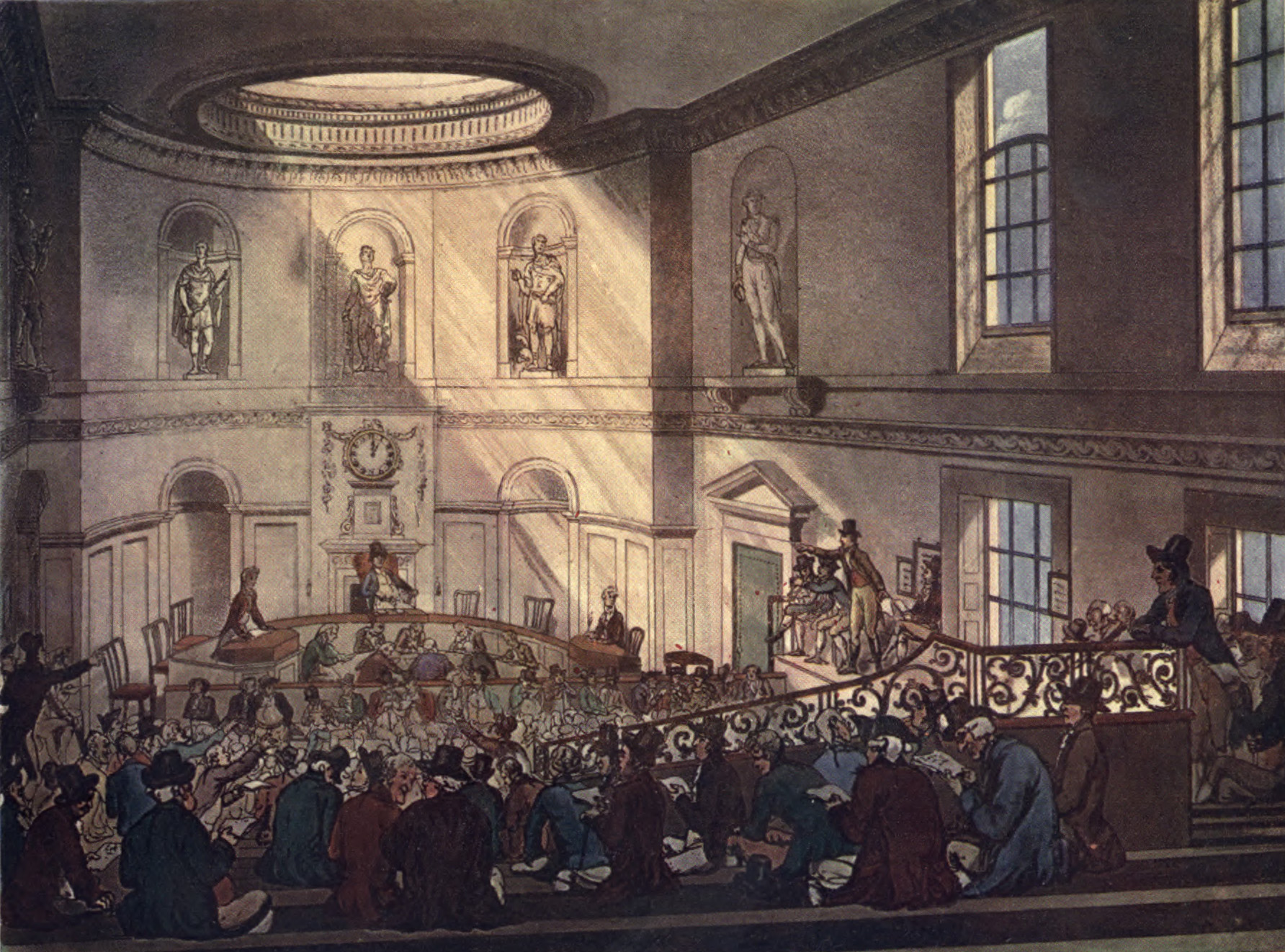
Illustration: “India House. Sale Room.” by Thomas Rowlandson et al.
By Pseudo-Matthew Desmond
Published April 20, 2023
Years before he was acquitted of charges High Crimes and Misdemeanors, Warren Hastings was Governor-General in a “trading” company that had acquired the rights to collect revenue in Bengal, Bihar, and Orissa—places which had since then become sites of growing bribery, corruption, and extortion. Previously this quasi state had maintained the appearance of acting within the Mughal system of government, but in Hastings’ hands it increasingly began to drop the appearance. In a minute to the Bengal Select Committee, Hastings wrote, “the sword which gave us the dominion of Bengal must be the instrument of its preservation.“ Hasting explained that if, “it shall ever cease to be ours, the next proprietor will derive his right and possession from the same natural charter.“
At his impeachment trial in 1788, Hastings defended his actions in India by arguing, “the whole history of Asia is nothing more than precedents to prove the invariable exercise of arbitrary power.“ It’s a fatalistic world view rooted in Orientalism that seems to get repeated even today when modern scholars write about India’s past. But across history, there have been many types of scholarships on India—from Vedic seers to Buddhist monks, Greek diplomats to Chinese pilgrims, Arab historians to Persian scholars—that present markedly different images of India’s past. When modern scholars declare that the British were responsible for the “literary treasures of Hindustan being opened up to the wonder and admiration of the world“—as a Whig historian told members of the Royal Asiatic Society in London at a gathering in the nineteenth century—what they’re often defending is the modern world’s peculiarly colonial knowledge economy. “Colonial Indology,“ the University of Cambridge historian Dilip K. Chakrabarti has called it. In this knowledge economy, academic scholars in India echo the Western line of thinking about India’s past to compete for grants and positions; so-called dhotiwalas are dismissed as fundamentalists of no intellectual consequence; mass culture in the West drives academic scholarship on India. Today in India, the majority of academic scholarship on India’s past revolves around colonial imaginings—the history of Indian society is viewed almost entirely through the prism of caste—with “a near-complete erasure of India’s knowledge systems in every field (Hypocrisy and Indian History).“
Or consider the many schools of history that have developed in India since independence. The Nationalist School, which reigned from the late 1940s to 1950s, emphasized a fundamental unity underlying India’s diversities. The Marxist School, which gained prominence in the 1960s, stressed economic factors as driving change from the earliest times. That was soon followed by the rise of the Cambridge School which looked at the growth of Indian nationalism through the lens of elite competition. The Subaltern School shifted focus to history from below in the 1980s. That was accompanied by the rise of schools around gender, caste, and indegeniety. But despite this seeming breadth, the current academic discourse on the rise of the Bharatiya Janata Party is modeled after The Hindu Nationalist Movement and Indian Politics: 1925 to the 1990s, a work by a French political scientist that forces India’s politics into categories of ethnic and universalist nationalism—asserting “the former type being epitomised by [Nazi] Germany and the latter by [?] France“ (Jaffrelot 13).

The 1854 Project is an ongoing initiative from the Institute for ReWriting World History that began in April 2023, the 169th anniversary of the publication of Outlines of the Philosophy of Universal History, Applied to Language and Religion. It aims to reframe India’s history by placing the consequences of colonialism and the contributions of Indians, at the very center of India’s many narratives. Read all the stories.
Those searching for reasons India’s historiography is uniquely colonial have found answers in many places (‘over-developed’ state apparatus, postcolonial amnesia, failure of national culture). But recently, postcolonial scholars have pointed persuasively to the pent-up offices of East India House and the opaque networks of the Royal Asiatic Society, to the archival rooms and the guest lecture halls, as the birthplace of the modern colonial approach to the study of the languages, cultures, histories, and religions of the Indian subcontinent.
Colonialism was undeniably a font of phenomenal wealth.

Or consider the quote by Sir William Jones—“[t]he Sanscrit language, whatever be its antiquity, is of a wonderful structure; more perfect than the Greek, more copious than the Latin,“ often cited by Indologists to deflect from the racist framework underlying their scholarship. What is less often cited, is the immediately preceding sentence, where Jones argues “Sanscrit was introduced by conquerors from other kingdoms in some very remote age.“
This accumulation knowledge, however, was significant not only for what it made visible, but also what it obscured. When reports of the brutality of the company’s administration started surfacing in England, they were managed by company scholars, who played on stereotypes to deny, attack, and reverse the victim and offender. More often company scholars proceeded by attacking the character and religion of the Indians, becoming basis for colonial rule.
Transregional Trade and Traders
Writing the Mughal World
Bhakti and the Bhakti Movement
Bengal Industries and the British Industrial Revolution
FOOTNOTES
BIBLIOGRAPHY
- Rowlandson, Thomas, and Augustus Charles Pugin. India House, the Sale Room (Plate 045, The Microcosm of London), 1809.